Key Takeaways:
- The CPF scheme is a social security savings scheme that helps Singaporeans and PRs save money for retirement and healthcare costs.
- CPF members can make voluntary top-ups to their own and their family members’ CPF accounts, enjoying tax relief on their contributions.
- The SRS is a voluntary savings scheme open to Singaporeans, PRs and foreign Singapore residents who want to save and invest for retirement while enjoying tax benefits.
- SRS account holders enjoy tax relief on their contributions.
The Central Provident Fund (CPF) scheme and Supplementary Retirement Scheme (SRS) are designed by the government to help support Singaporeans for retirement. When used correctly, they can contribute to your long-term financial security.
Making voluntary contributions to your CPF Special Account (SA) or SRS not only helps to compound your savings over time and increase your future retirement income, but also provides tax relief, hence lowering your taxable income—something extremely desirable for well-heeled, high-income earners.
However, many Singaporeans are still unsure whether it is better to top up their CPF accounts or contribute to their SRS accounts. Both offer tax relief but come with different rules and perks.
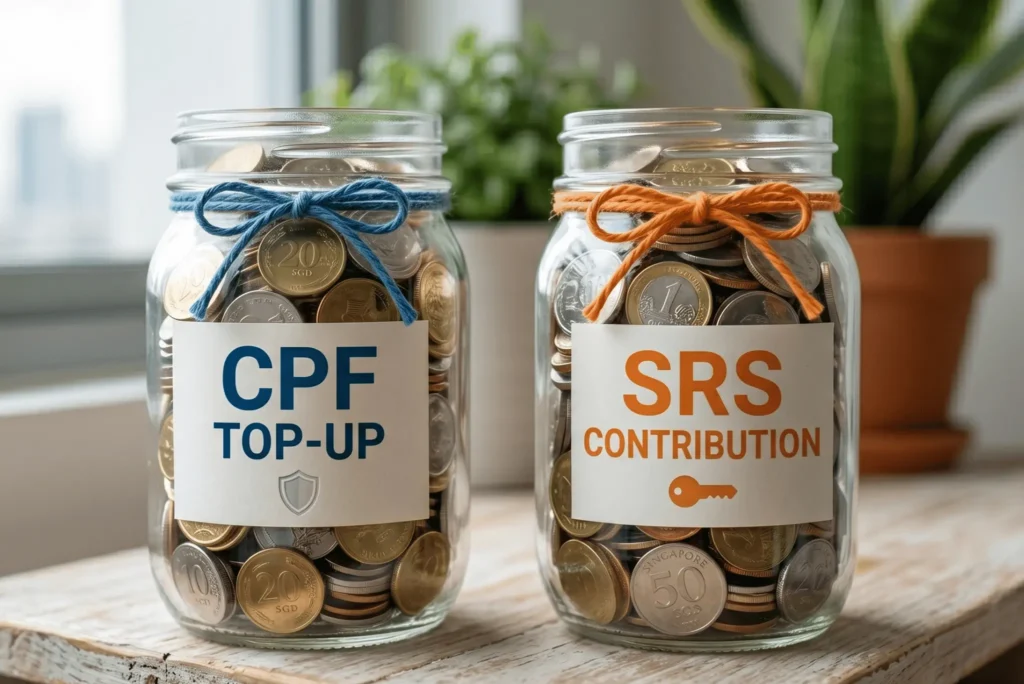
In this guide, we’ll compare CPF vs SRS top-ups for tax relief, as well as the differences, limitations and benefits of both methods. With this information in hand, you’ll be able to choose the method that best serves your financial goals.
SRS vs CPF Overview
| CPF | SRS | |
| Purpose | Save for retirement | Set aside extra retirement savings and grow them through investments while enjoying tax concessions |
| Eligibility | All Singapore citizens and PRs | Singapore citizens, PRs and foreigners aged 18 and above who are not undischarged bankrupts |
| Interest rate |
|
0.05% for idle funds |
| Contribution cap | Annual mandatory and voluntary contribution limit of S$37,740 | S$15,300 for Singaporeans and PRs, S$35,700 for foreigners |
| Withdrawal rules | At age 55, can withdraw excess of Full Retirement Sum (FRS) in OA, or S$5,000 if FRS is not met. Monthly payouts start anytime between the ages of 65 and 70 | Can make SRS withdrawals anytime, but withdrawing before the statutory retirement age incurs a 5% penalty and makes withdrawals fully taxable |
| Investment options | Can invest OA and SA through CPF Investment Scheme (CPFIS) | Investment instruments include shares, unit trusts, bonds, fixed deposits, certain life insurance products and ETFs |
| Tax relief amount |
|
Up to the SRS contribution limit |
The CPF System: Rates, Eligibility & Payout Age
CPF is a mandatory social security savings scheme for Singapore citizens and PRs, who are called CPF members. Its main purpose is to encourage individuals to take ownership of their finances and provide a baseline of savings for retirement and healthcare.
CPF accounts
All CPF members have the following CPF accounts:
- Ordinary Account (OA): Savings can be kept for retirement but also used for selected purposes, including housing, some types of insurance, local tertiary institution tuition fees, and select investments through the CPF Investment Scheme-Ordinary Account (CPFIS-OA).
- MediSave Account (MA): Savings can only be used for healthcare.
- Special Account (SA): Savings are mainly for retirement and earn higher interest rates than OA. Can also be invested through the CPF Investment Scheme-Special Account (CPFIS-SA).
- Retirement Account (RA): At age 55, the funds in your OA and SA merge to form the RA, whose main purpose is to hold retirement savings.
CPF interest rates
Here are the current CPF interest rates.
| OA | SA, MA, RA | |
| CPF interest rate (per annum) | 2.5% | 4% |
In addition, CPF members also enjoy extra interest on the first S$60,000 of their combined CPF balances, capped at S$20,000 in the OA.
| Age | CPF extra interest (per annum) |
| Below 55 | 1% |
| 55 and above | 2% on first S$30,000, 1% on next S$30,000 |
CPF contribution rates
For salaried employees, their CPF contributions are deducted from their salary by their employer and paid into their CPF accounts. Their employer must also make separate employer contributions that do not make up part of their salary.
The CPF contribution rates are currently, as of writing in May 2026, as follows:
| Age | Contribution rates for monthly wages of S$750 and above (% of wage) | ||
| By employer | By employee | Total | |
| 55 and below | 17 | 20 | 37 |
| Above 55 to 60 | 16 | 18 | 34 |
| Above 60 to 65 | 12.5 | 12.5 | 25 |
| Above 65 to 70 | 9 | 7.5 | 16.5 |
For self-employed persons, contributions to all CPF accounts except the MA are voluntary.
CPF withdrawal
At age 55, you can make your first CPF withdrawal, the amount depending on whether you have met the FRS.
If you have, you can withdraw any funds in excess of the FRS via your OA. If you are a property owner, you can meet the FRS with a mixture of property and cash, with property making up to half of the FRS.
If you have not met the FRS, you can only withdraw S$5,000 at the moment.
Your CPF monthly payouts will then start anytime between the ages of 65 and 70, depending on your preference.
Investing your CPF
Under the CPFIS-OA and CPFIS-SA, you can invest your savings in certain financial products in hopes of obtaining higher returns than the CPF interest rates (yes, you can earn risk-free interest on your CPF monies by leaving them idle).
For the CPFIS-OA, you must be able to set aside S$20,000 in your OA before you can invest the remainder. For the CPFIS-SA, you must be able to set aside S$40,000 in your SA.
The types of financial products you can invest in include the following:
- Investment-Linked Insurance Policies (ILPs)
- Unit trusts
- Exchange Traded Funds (ETFs)
- Fixed deposits
- Singapore government bonds
- Corporate bonds
- Treasury bills
- Shares
- Property funds
- Gold products
How CPF Top-Ups Work
CPF members can make voluntary contributions to their CPF SA (for those below 55) or RA (for those aged 55 and above) through the Retirement Sum Topping-Up Scheme.
Making voluntary CPF top-ups not only boosts your retirement income but also enables you to earn guaranteed interest rates of up to 6% and up to S$8,000 of tax relief per calendar year.
You can also top up the CPF accounts of your family members to receive further tax relief of up to S$8,000 per year. The total amount of tax relief you can enjoy for making CPF top-ups is thus S$16,000.
Top-ups made to your CPF MA also qualify for tax relief, and the top-up cap applies to the total of SA/RA and MA top-ups, as illustrated below.
| Amount of cash top-up to own or family members’ CPF SA/RA/MA | Maximum allowable tax relief |
| Below S$8,000 | Exact amount of cash top-up |
| S$8,000 or more | S$8,000 |
Note that there is a cap on the amount of retirement savings top-ups that qualify for tax relief, whether to your own account or family members’. For individuals below 55, the cap is the current year’s FRS, which is S$220,400 in 2026. For those 55 or above, the limit is capped at the Enhanced Retirement Sum (ERS), which is S$440,800 in 2026 and S$456,400 in 2027.
How to Make CPF Top Ups for Tax Relief
1) Navigate to the CPF Board’s CPF cash top-up page.
2) Accept the terms of use and click [Start].
3) Log in with your Singpass.
4) Select [Cash top-up via PayNow QR] and click [Next].
5) Select [Myself] or [My loved one], depending on whose CPF account you wish to top up, and enter the amount, verify your contact details, select an option to indicate how you learnt of the service and click [Next].
6) Review your application, agree to the declaration and terms and conditions, and click [Confirm].
7) Scan the PayNow QR code using your bank’s app to approve the transaction.
Be aware that any top-ups are irreversible and should not be made unless you intend to boost your own or your family members’ retirement savings.
The SRS System: Rates, Eligibility, What It Is For
SRS is a voluntary savings scheme that enables Singaporeans, PRs and foreigners to grow their retirement savings. It is designed to complement the CPF system, and can also be used by foreign residents who are not CPF members.
So, what is the SRS to be exact? To participate in the scheme, you’ll open an SRS account and transfer money with the goal of investing it for retirement.
You’ll receive tax relief on SRS contributions and also enjoy a 50% tax concession on your investment gains if you wait until the statutory retirement age to withdraw, or are allowed to withdraw earlier on medical grounds. The retirement age that applies to you will be that which was prevailing at the time of your first contribution.
It is not advisable to withdraw before the statutory retirement age, as your withdrawal will not only be fully taxable, but it will also incur a 5% penalty!
SRS contribution cap
Based on your Singapore residency status, there are yearly SRS contribution caps, as follows:
| Residency status | Annual SRS contribution cap |
| Singapore citizens and PRs | S$15,300 |
| Foreigners | S$35,700 |
You can contribute to your SRS savings at any time and as frequently as you like within the year, up to the annual contribution cap.
SRS withdrawal rules
Singaporeans and Singapore PRs can make SRS withdrawals at any time. However, early withdrawals before the statutory retirement age are fully taxable and subject to a 5% penalty.
On the other hand, if you withdraw on or after the statutory retirement age, only 50% of the withdrawn amount is taxable, making it more tax-efficient.
For foreigners, penalty-free withdrawals can be made only after 10 years from the date of the account opening, and only 50% of the amount is subject to tax. However, early withdrawals will incur a 5% penalty and are fully taxable.
You can choose to withdraw your SRS savings either in one lump sum or spread it over a period of up to 10 years, starting from your first withdrawal. Spreading your SRS withdrawals over 10 years instead of making a lump-sum withdrawal can be more tax-efficient, as it lowers your taxable income bracket.
SRS account interest rate
The SRS account interest rate is a meagre 0.05% p.a. It is thus a good idea to invest your SRS savings for capital gains rather than using SRS solely as a tool to enjoy income tax relief.
Investing SRS funds
You can invest your SRS funds in the following approved products:
- Shares
- Unit trusts
- Bonds
- Fixed deposits
- Certain life insurance products (subject to limits)
- ETFs
How SRS Top-Ups Work: Step-by-Step Guide
You will first need to open an SRS account with DBS, UOB or OCBC. Take note: you may only hold one SRS account at a time.
All contributions must be made in cash, and you receive dollar-for-dollar tax relief for them.
Example
If you earn S$60,000 a year, here’s how making a S$15,000 SRS contribution will affect your tax bill.
| Annual income | S$60,000 |
| SRS contribution | S$15,000 |
| Tax relief | S$15,000 |
| Total taxable income | S$45,000 (S$60,000 – S$15,000) |
You can calculate your tax savings from SRS with an SRS calculator.
SRS vs CPF: Which One Should You Top Up?
If you are a CPF member with an SRS account, you might be wondering which is more beneficial to top up. Truth be told, that depends on your goals for the funds, your risk tolerance and other factors.
When to top up CPF SA
The interest rates offered by the CPF SA are highly attractive. They are also guaranteed by the Singapore government, and thus virtually risk-free. This option can be good for those with a low risk tolerance or those who prefer not to do anything at all.
However, you have to be comfortable locking your funds in for the long term, and you should be gunning for stable, boosted monthly retirement payouts.
When to top up SRS
The funds in your SRS account enjoy more investment flexibility than CPF savings. However, because you will need to invest your funds, this option is suitable only for those comfortable with a certain amount of risk.
Ideally, you should aim for higher returns, potentially achievable via blue-chip stocks or ETFs, rather than settle for lower-yield investment products like bonds and unit trusts. Also, for maximum tax relief efficiency, you will have to resist withdrawing your SRS funds for the foreseeable future, up until your statutory retirement age.
When it comes to tax relief, SRS top-ups are also subject to a higher yearly cap of S$15,300 for Singapore citizens and PRs, compared to S$8,000 per annum for CPF top-ups to your own account.
If you found this helpful, you might enjoy these articles, too:
Cost of Owning a Car in Singapore 2026: COE & Running Costs
Payday Loans Guide: What It Is & How to Apply in Singapore
Secured Loan vs Unsecured Loan: Key Differences Explained