Key Takeaways
- The best eSIM for Japan depends on your travel style: Ubigi offers the best all-around value for most travellers, while Holafly is the go-to for unlimited data, and Airalo suits flexible, budget-friendly plans.
- eSIM roaming is significantly cheaper than traditional roaming — expect to pay as little as S$3.50 for a short trip compared to S$15/day with a local telco roaming plan, saving you hundreds on a two-week holiday.
- All major travel eSIM providers in this comparison rely on Japan’s big three carriers: NTT Docomo (best nationwide coverage), KDDI/au, and SoftBank, so signal quality is broadly similar. The key differentiators are price, data caps, and extra features like hotspot tethering and 5G support.
- For travellers who need a Japanese phone number for restaurant reservations or long-term stays, Mobal is one of the very few providers offering voice + data plans to short-term visitors.
Japan is a favourite travel spot for Singaporeans, thanks to its four distinct seasons—from cherry blossoms to snowy winters—plus amazing food and shopping. A historically favourable SGD-JPY exchange rate also makes it a fantastic value.
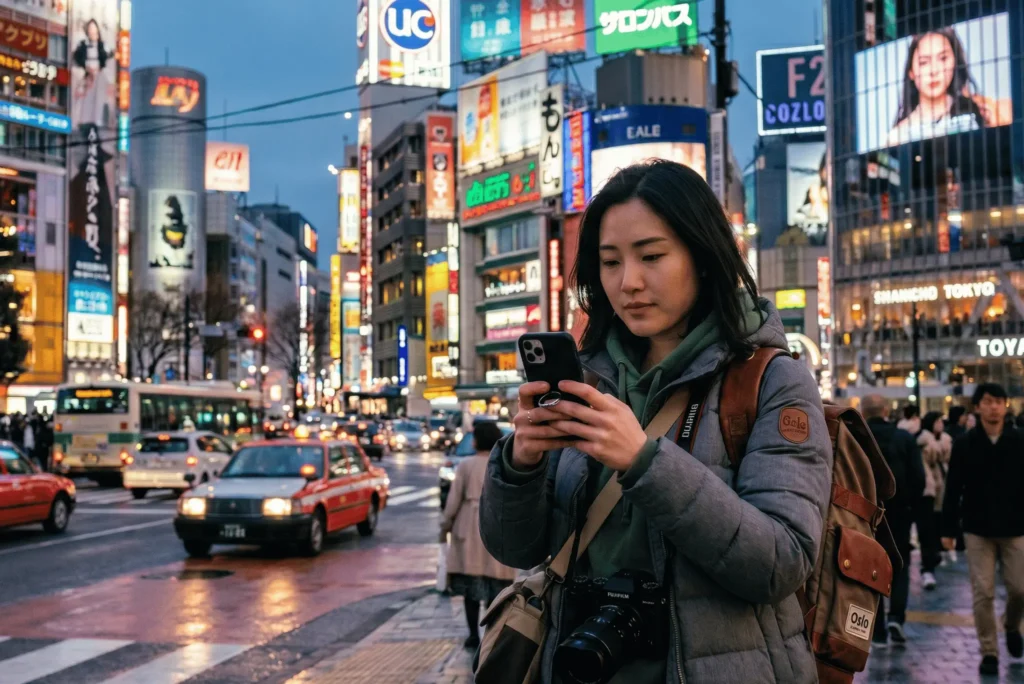
Yet for all its wonders, it’s tough to stay connected in Japan. Reliable, high-speed internet is a necessity; you’ll need it to decode a kanji-only menu with Google Translate, navigate the labyrinthine train network, check Google Maps for the next Shinkansen departure, or simply upload that perfect torii gate photo to Instagram.
This is where the best eSIM for Japan comes in. A travel eSIM is a hassle-free, affordable alternative that lets you connect to local Japanese mobile networks the moment you land without visiting a store, swapping a physical SIM card, or worrying about hidden roaming fees.
In this article, we compare the top six providers of eSIM for Japan: Airalo, Mobimatter, Saily, Holafly, Mobal, and Ubigi, across pricing, data plans, network coverage, and overall value, so you can pick the best option for your trip. Intrigued? Dive in now!
What Is an eSIM and How Does It Work?
An eSIM (embedded SIM) is a digital SIM built directly into your smartphone.
Unlike a traditional physical SIM card, it does not require a plastic chip that you insert or swap. Instead, you purchase a data plan online, receive a QR code, scan it with your phone, and a virtual SIM profile is downloaded to your device—all within minutes!
Activation is 100% digital; there is nothing to carry, nothing to lose, and nothing to fumble with when you land at Narita or Kansai International Airport.
For frequent travellers, this convenience is a game-changer. There is no need to queue at airport SIM card counters, compare plans on the spot in a language you may not speak, or waste precious time dealing with connectivity logistics. An eSIM for Japan can be purchased and installed days before your flight, and you simply toggle it on when the plane touches down.
The adoption of eSIMs has surged globally. In 2025, an estimated 605 million eSIM units were shipped worldwide, an 18% increase over the previous year, driven by broader adoption in consumer smartphones and connected devices. Hotels, airlines, and travel platforms increasingly recommend eSIMs as the default choice for staying connected abroad.
Is an eSIM Better than a Physical SIM in Japan?
Both eSIM roaming and physical SIM cards ultimately do the same thing: connect your phone to a local mobile network. But the travel experience they offer is quite different. Below is a quick breakdown of the main differences.
Pros and Cons of eSIMs vs. Physical SIMs


Signal Strength: Is There a Difference?
Signal strength for both eSIMs and physical SIMs is effectively the same.
The quality of your connection depends on factors such as your device’s antenna, distance from the nearest cell tower, network congestion, and physical obstacles, not on whether the SIM is embedded or removable.
For example, an Airalo eSIM and a physical SoftBank SIM on the same network in the same location will deliver nearly identical performances.
Do You Need a Japanese Phone Number?
One important note: getting a SIM card or eSIM with a Japanese phone number (for voice calls and SMS) is heavily restricted for non-residents of Japan.
Most travel eSIM options sold to tourists are data-only. If you absolutely require a local Japanese phone number—for instance, to make restaurant reservations, call accommodations, or set up certain local services—Mobal is one of the very few companies that offers voice + data eSIM plans to short-term visitors, complete with a real Japanese phone number (more on this below).
Quick Comparison Table: eSIM vs Physical SIM
| Feature | eSIM | Physical SIM |
| Form Factor | Embedded chip (digital profile) | Removable plastic card |
| Device Compatibility | Newer smartphones only | Almost all unlocked smartphones |
| Activation | Scan QR code, activate via app | Insert card, configure APN |
| Multiple Profiles | Supports multiple stored profiles | One per slot (unless dual SIM) |
| Switching Devices | Requires re-downloading profile | Swap card between devices |
| Security | Cannot be physically stolen or lost | Can be lost, damaged, or stolen |
| Setup Time | Minutes; doable before or during the trip | Purchase at the store or pre-order delivery |
| Signal Strength | Identical to a physical SIM on the same network | Identical to eSIM on the same network |
Best eSIM for Japan: 6 Providers Compared
Below is a side-by-side overview of the six best eSIM providers. Exact rates may fluctuate with promotions and currency movements; always check the provider’s website for the latest pricing.
| Provider | Starting Price (SGD) | Data Packages | Max Data | Package Type | Max Speed | Validity | Key Networks |
| Airalo | ~S$5.50 | 1GB–20GB, Unlimited | 20GB (fixed) / Unlimited | Data total | 4G LTE | 3–30 days | SoftBank |
| Mobimatter | S$5.50 | 1GB–50GB+ | 50GB+ | Data total | 4G / 5G (varies) | 5–30 days | IIJ (Docomo), others |
| Saily | S$5.00 | 1GB–Unlimited | Unlimited | Data total | 4G / 5G | 7–60 days | KDDI, others |
| Holafly | S$8.00/day | Unlimited only | Unlimited (FUP applies) | Per day | 4G / 5G | 1–90 days | SoftBank, KDDI |
| Mobal | ~S$25 (one-off) | 10GB–30GB (tourist) / 1–50GB/month (voice) | 30GB (tourist) / 50GB (voice) | Data total | 4G / 5G | 8–30+ days | Docomo |
| Ubigi | S$4.40 | 1GB–Unlimited | Unlimited | Data total | 5G | 3 days–12 months | NTT Docomo, KDDI |
Sources: Gizmodo Japan eSIM comparison 2026, MyBestSim Japan eSIM guide 2026, Airalo & Saily & Holafly comparison. Verified as of April 2026.
1. Airalo
Airalo is the world’s largest eSIM provider, covering over 200 countries and destinations. It is known for its user-friendly app, flexible plans, and reliable 4G LTE connectivity. In Japan, Airalo primarily connects to the SoftBank network, offering solid performance across all major cities and tourist areas.
Key Perks:
- Very affordable entry-level plans, perfect for light users and short stays.
- Easy-to-use app with data consumption tracking for iOS and Android.
- 24/7 live chat customer support.
- Unlimited data plans available for heavier users (from S$15 for 3 days up to S$92 for 30 days).
- Seamless QR code activation: scan, install, and connect within minutes.
Airalo eSIM for Japan Plans (2026)
| Data | Validity | Approx. Price (SGD) |
| 1 GB | 3 days | S$5.50 |
| 3 GB | 3 days | S$10.00 |
| 5 GB | 7 days | S$13.00 |
| 10 GB | 7 days | S$22.00 |
| 20 GB | 15 days | S$31.00 |
| Unlimited | 3 days | S$15.00 |
| Unlimited | 10 days | S$45.00 |
| Unlimited | 30 days | S$92.00 |
2. Mobimatter
Mobimatter takes a different approach: instead of offering its own plans, it operates as a marketplace aggregator for eSIMs. The app gives you access to hundreds of plans from multiple telecom providers, allowing you to filter by data amount, validity, and price to find exactly what you need. For Japan, Mobimatter surfaces plans running on Japanese networks, including IIJ (which operates on NTT Docomo’s infrastructure).
Key Perks:
- Competitive pricing with plans starting as low as S$6 for 3GB/5 days.
- Access to high-data plans is rarely found elsewhere (e.g. 50GB for 30 days around S$40).
- Supports over 190 destinations, making it ideal for multi-country Asia trips.
Mobimatter eSIM for Japan Plans (2026)
| Data | Validity | Approx. Price (SGD) |
| 1 GB | 14 days | S$5.50 |
| 3 GB | 5 days | S$6.00 |
| 5 GB | 30 days | S$8.00 |
| 10 GB | 30 days | S$11.00 |
| 30 GB | 30 days | S$30.00 |
Because Mobimatter is a marketplace, plan availability and exact pricing can shift based on which telecom partners are active. It is a fantastic option for travellers who want the best price-per-GB and are comfortable browsing multiple plan options in the app.
3. Saily
Saily is the eSIM service from NordVPN, a well-known cybersecurity company. This gives it a unique angle: every Saily plan includes built-in security features such as a virtual ad blocker and malicious URL detection. In Japan, Saily connects to local carriers (NTT Docomo or KDDI) and offers plans from a modest 1GB all the way up to unlimited data.
Key Perks:
- Integrated security tools (ad blocker, malicious site protection) for safer browsing on public Wi-Fi.
- No hotspot/tethering restrictions—share your connection freely!
- Instant activation with one-click setup.
- 24/7 chat support and a generous 30-day window to activate after purchase.
- Saily Ultra plan (~SS$75/month) includes 30GB of monthly data across multiple countries (with slow but unlimited data thereafter), full NordVPN, NordPass, and additional security suite for digital nomads.
Saily eSIM for Japan Plans (2026)
| Data | Validity | Approx. Price (SGD) |
| 1 GB | 7 days | S$5.00 |
| 3 GB | 30 days | S$10.00 |
| 5 GB | 30 days | S$14.00 |
| 10 GB | 30 days | S$23.00 |
| 20 GB | 30 days | S$31.50 |
| Unlimited | 10 days | S$44.00 |
| Unlimited | 30 days | S$91.00 |
Saily is a strong mid-range choice, particularly for travellers who value online privacy and want the reassurance of a trusted security brand behind their connectivity.
4. Holafly
Holafly eSIM takes a refreshingly simple approach: every plan comes with unlimited data. There is no need to calculate GBs, no anxiety about running out mid-trip, and no top-ups to worry about. For Japan, Holafly uses the SoftBank and KDDI networks with 4G LTE, and 5G support, delivering smooth, high-speed connectivity across the country.
Key Perks:
- Truly unlimited data with no speed cap—stream, browse, and share without restraint!
- Hotspot/tethering supported (limited to 1GB/day).
- Easy QR-code setup, no app required, although one is available.
- Flexible durations from 1 day up to 90 days.
- 24/7 live chat customer support in multiple languages.
Holafly eSIM for Japan Plans (2026)
| Duration | Price (SGD) | Price Per Day |
| 1 day | S$8.00 | S$8.00 |
| 3 days | S$17.00 | S$5.67 |
| 4 days | S$21 | S$5.25 |
| 5 days | S$27 | S$5.40 |
| 7 days | S$39 | S$5.57 |
| 14 days | S$63 | S$4.50 |
| 21 days | S$85 | S$4.05 |
| 30 days | S$100 | S$3.33 |
*You’d think economies of scale apply here, but it’s not always consistently the case.
Fair Usage Policy note: While Holafly markets its data as unlimited, most plans are subject to a Fair Usage Policy. This typically means high-speed data is provided without a hard cap, but speeds may be throttled during times of extreme network congestion. In practice, most travellers report excellent speeds throughout their trips.
5. Mobal
Mobal occupies a unique niche in Japan: it is one of the very few providers that offer a genuine Japanese phone number to short-term visitors. This is invaluable if you need to make phone calls for restaurant reservations, contact accommodations, or set up services that require SMS verification. Mobal’s eSIMs run on the NTT Docomo network, Japan’s largest and most reliable carrier, ensuring excellent nationwide coverage.
Key Perks:
- Voice + data plans with a real Japanese phone number (starting with 080 or 090).
- Free incoming calls and texts.
- Data-only short-term plans available.
- Long-term monthly plans for expats, students, and working holidaymakers.
- English-language customer support.
- No contract, cancel anytime.
Mobal eSIM for Japan Plans (2026)
| Plan Type | Duration | Data | Approx. Price (SGD) |
| Data-Only (Tourist) | 8 days | 10 GB | S$25.00 |
| Data-Only (Tourist) | 8 days | 30 GB | S$28.00 |
| Voice + Data | 30 days | 10 GB | S$72.00 |
| Voice + Data | Long-term | 1–50 GB per month | S$32 initial purchase + S$13+/month thereafter depending on plan |
Best for: Travellers who need to make phone calls, long-term visitors, and anyone exploring rural areas where Docomo’s superior coverage makes a difference.
6. Ubigi
Ubigi consistently tops “best of” lists for Japan eSIMs for good reason. It is owned by Transatel, a subsidiary of NTT, the Japanese telecom giant that also operates NTT Docomo. This gives Ubigi privileged access to Japan’s best mobile infrastructure, including 5G on both NTT Docomo and KDDI networks. The result is exceptional speed, low latency, and coverage that reaches even remote areas.
Key Perks:
- Supports hotspot/tethering without limits, so you can share your connection with other devices freely.
- 5G connectivity on Japan’s top two networks for maximum coverage and speed.
- Works seamlessly across 200+ countries if your trip extends beyond Japan.
- Free connectivity for top-ups when you run out of data and have no Wi-Fi.
Ubigi eSIMs for Japan Plans (2026)
| Data | Validity | Approx. Price (SGD) |
| 1 GB | 3 days | S$4.40 |
| 3 GB | 15 days | S$9.50 |
| 5 GB | 15 days | S$13.00 |
| 10 GB | 30 days | S$20.00 |
| 25 GB | 30 days | S$40.60 |
| Unlimited | 7 days | S$31.70 |
| Unlimited | 15 days | S$49.50 |
| Unlimited | 30 days | S$82.50 |
In real-world tests across Tokyo and Osaka, Ubigi delivered exemplary 5G speeds suitable for streaming Netflix, gaming, and video calls without lag. The unlimited tethering is a standout feature for those travelling with a laptop or tablet, or for companions who need to piggyback on a single connection. For the best balance of speed, coverage, price, and flexibility, Ubigi is very hard to beat.
How to Choose the Best Japan eSIM Plan?
With six strong contenders, how do you decide? Here are the key factors to weigh when picking your ideal eSIM for Japan.
1. Coverage: Which Network Backs Your eSIM?
Japan’s mobile landscape is dominated by four major carriers:
- NTT Docomo (~40% market share, eSIMs: Saily, Mobal, Ubigi): The market leader with the best nationwide coverage, including rural and mountainous areas. Its 5G infrastructure is the most developed, available in over 500 cities. eSIMs on Docomo are the best choice for travellers venturing beyond major cities into places like Hokkaido, the Japanese Alps, or Okinawa.
- KDDI/au (~30% market share, eSIMs: Saily, Holafly, Ubigi): Excellent coverage in urban areas and tourist zones, with very high 4G and 5G speeds. Often rated the best consumer connectivity experience.
- SoftBank (~25% market share, eSIMs: Airalo and Holafly): First to deploy a commercial 5G network in Japan. Excellent performance in Tokyo, Yokohama, Osaka, and Fukuoka. Competitive pricing.
- Rakuten Mobile (~7% market share): The newest network with the lowest prices. Coverage is growing rapidly but is still less reliable than the big three, particularly outside urban centres. It automatically roams onto KDDI’s network outside its own coverage zone.
Takeaway: If you are staying within Tokyo, Kyoto, and Osaka, any network will serve you well. If your itinerary includes rural areas, ski resorts, or off-the-beaten-path destinations, prioritise an eSIM on NTT Docomo’s network (Saily, Mobal, or Ubigi) for the most reliable coverage.
2. Data Usage Needs
Be honest about your browsing habits:
- Light users (maps, messaging, light social media, occasional web browsing): 1–2GB per day is sufficient. A 5–10GB plan will comfortably cover a week-long trip.
- Medium users (regular social media with post/story uploads, music streaming, lots of Google Maps, some YouTube): Budget 2–3GB per day. A 20GB plan works well for a week to 10 days.
- Heavy users (HD video streaming, video calls, large file uploads, gaming, hotspot sharing): Consider unlimited plans from Holafly or Ubigi, or a large 50GB plan from Mobimatter or Saily.
3. Fair Usage Policy (FUP)
“Unlimited data” does not always mean truly unlimited. Many providers apply a Fair Usage Policy: after a certain daily or monthly threshold of high-speed data, your connection may be throttled to slower speeds (often around 1Mbps or less).
For instance, some unlimited plans cap high-speed data at 2GB per day before slowing down. Always read the fine print before purchasing, especially if you plan to stream or video call extensively.
4. Data Speeds: 4G vs 5G
For most travellers, 4G LTE is more than sufficient. It handles Google Maps, Google Translate, social media, and basic browsing with ease. 5G is only truly necessary if you plan on heavy streaming (Netflix, YouTube in 4K), doing large file uploads, or cloud-based work. Do not overpay for 5G if you do not need ultra-fast speeds; providers like Airalo are still perfectly adequate for the vast majority of travel use cases.
5. Data-Only vs. Call Plans
Most eSIM for Japan plans are data-only, which is perfectly fine for the vast majority of travellers. Modern smartphones support dual-SIM functionality, meaning you can keep your Singapore line active to receive SMS OTPs (for banking, 2FAs, etc.) while using the eSIM purely for data while overseas.
Consider a call-enabled plan only if you:
- Need to make phone calls to Japanese businesses (restaurants, hotels).
- Are staying long-term and setting up bank accounts or utilities.
- Require SMS verification from Japanese services.
In those cases, Mobal is your best bet for a plan that includes a voice line and a real Japanese phone number.
6. Validity Period
eSIM plans come in all shapes: some last 3 days, others 30 days, and a few offer annual or subscription-based options. Match the validity to your trip duration. There is no point paying for a 30-day plan if you are visiting Japan for only 7 days unless you plan to return soon and want to keep the eSIM active.
How Much Data (GB) Do I Need for My Japan Trip?
Here is a quick guide based on typical traveller profiles, informed by real-world usage data from Japanese travel SIM providers:
| User Type | Data Per Day | For a 7-Day Trip | For a 14-Day Trip | Typical Activities |
| Light (Essentialist) | 0.5–1GB | 5–10GB | 10–15GB | Maps, messaging, light browsing, occasional photos |
| Medium (Most Travellers) | 1–2GB | 10–15GB | 15–25GB | Maps, social media (incl. stories), music streaming, Google Translate, and some YouTube |
| Heavy (Streamer/Digital Nomad) | 2–5GB+ | 20–30GB+ | 30–50GB+ | HD video streaming, video calls, gaming, large uploads, and hotspot sharing |
Most travellers fall into the Light or Medium category. Around 1–2GB per day is the realistic sweet spot for typical sightseeing. Unlimited data is only necessary if you stream a lot of video or use your phone as a primary work device.
Conclusion
The best eSIM for Japan ultimately depends on your travel style, data habits, and budget. Here are our top picks by traveller type:
- Budget Traveller: Mobimatter remains the king of price-per-GB, with a 10GB/30 day plan at just S$11 and even a 30GB/30day option at S$30. Airalo and Saily are excellent for very light usage, starting from around S$5.50 and S$5.00 respectively for short trips.
- Heavy Data User / Streamer: Holafly is the all-you-can-eat champion: unlimited data with no speed cap starting from S$8.00/day. Ubigi’s unlimited plans are slightly more expensive for very short stays but offer 5G and unrestricted tethering (unlike Holafly, which restricts sharing to 1GB/day), making it the better choice if you need to hotspot a laptop or tablet.
- Short Weekend Trip (1–3 days): Ubigi now offers the cheapest entry at S$4.40 for 1GB/3days. If you′re a heavy user and want unlimited data without counting, Holafly′s 1−day plan at S$8.00 (or 3 days at S$17.00) is a simple set-and-forget option.
- Long Stay / Digital Nomad: Ubigi dominates with a 25GB/30 day plan at S$40.60 and unlimited monthly at S$82.50—both with 5G on two networks and unlimited tethering. Mobal remains the go-to if you need a real Japanese phone number; a voice+data plan starts at about S$32 upfront + S$13/month.
- Privacy-Conscious Travellers: Saily still stands alone with its built-in NordVPN-powered security suite, making it the ideal pick for those who want safer browsing on public Wi-Fi. Prices are competitive, with a 10GB/30 day plan at S$23 and unlimited 10 days at S$44.
- Best All-Rounder: Ubigi continues to wear the crown. It blends the lowest entry price (S$4.40), the widest plan range, 5G on Docomo and KDDI, and unrestricted tethering into a package that suits nearly every traveller.
Before purchasing your Japan eSIM, always check that your device is eSIM-compatible and unlocked. Most iPhones from XS/XR onward, as well as recent Samsung Galaxy, Google Pixel, and other Android flagships, support eSIM. If in doubt, dial *06 on your phone; if you see an EID number, you are good to go!
When you are ready to plan the rest of your trip, check out our guides on the best multi-currency cards and travel cards, our Revolut vs YouTrip comparison, and our Wise vs YouTrip comparison to make sure you get the best exchange rates on your travel spending. If your travels take you north of the Lion City, our KTM train to JB guide, ETS from JB to KL guide, and Best Malaysia eSIM plans round out the journey.