


Key Takeaways
- Overview: Both Revolut and YouTrip offer multi-currency wallets and cards for overseas spending. Revolut is a “financial super-app”; in addition to travel spending, it offers budgeting tools, crypto/stock investing, and child/business accounts. YouTrip is focused on travel, with simpler features (no budgeting, no local banking) and supports 150+ currencies with zero fees.
- Fees: YouTrip charges no foreign transaction fees or annual fees, whereas Revolut’s free plan imposes fair-usage limits (e.g. S$5,000/month) and a 1% FX markup on weekends.
- ATM withdrawals: YouTrip offers up to S$400 of overseas ATM withdrawals per month free (then 2%); Revolut offers about S$350 free (then 2%).
- Ideal users: Revolut is better suited to those who prefer extra financial tools and don’t mind occasional fees (e.g. weekend FX markup). YouTrip suits travellers who want a fee-free travel card with the best FX rates on 12 popular currencies.
Worried about all that FX markup while you’re spending abroad? Multi-currency cards offer competitive rates and features to ease some of those travel woes. If you didn’t already know, the two most popular multi-currency cards in Singapore are Revolut and YouTrip. But, in the thick of the Revolut vs YouTrip conundrum, which one is the winner?
In this article, we’ll pit the YouTtrip card against the Revolut card and dive into their features, fees, and pros/cons. Read on to find out whether YouTrip or Revolut is a better fit for you!
What Is a Multi-Currency Account?
A multi-currency account lets you hold and exchange foreign currencies with exceptional ease, often with an attached debit card for spending abroad. Such accounts typically include features such as international money transfers and withdrawals in local currencies from ATMs abroad.
Traditional banks offer multi-currency accounts as well, but they often limit the number of currencies, charge higher fees, or don’t provide excellent exchange rates. In contrast, fintech providers like Revolut and YouTrip offer more currencies, low (or zero) fees, and near-market exchange rates. With just a smartphone app, users can easily top up funds, convert currencies, and spend globally with minimal fees.
In Singapore, popular options include Revolut, YouTrip, and Wise, each with its own strengths and drawbacks.
Overview: Revolut vs YouTrip
| Feature | Revolut | YouTrip |
| Eligibility | Residents of Singapore, UK, US, EEA countries, Switzerland, and Japan. | Residents of Singapore, Thailand, and Australia. |
| Currencies (holding/exchange) | 38 currencies. | 12 currencies. |
| Spendable currencies | 150+ worldwide; the card works globally except in some restricted countries. | 150+ worldwide; the card works anywhere Mastercard is accepted. |
| International transfers | Send money to many countries worldwide (fees from ~0.3%). | Can send money overseas from the SGD wallet to 40+ countries; transfers to other YouTrip users are instant and free. |
| Exchange rate | Uses Revolut’s own FX rate (very close to market rate on weekdays, but with markup on weekends). | Uses wholesale (mid-market) rate for its 12 currencies, and Mastercard’s wholesale rate for all others. No hidden markups. |
| Currency conversion fee | Standard plan: free, up to S$5,000/month (then 0.5–1% fee).
Higher plans raise limits (S$15k with 0.5% fee). |
0% conversion fee on all currencies; uses market rates. |
| Weekend FX markup | Standard plan adds 1% on weekends (Premium/Metal plans have no weekend fee). | No weekend/after-hours fees; still uses wholesale/Mastercard rates. |
| Exchange limits (fair usage) | Standard plan: S$5,000 free per month, then 1% fee.
Premium: S$15,000 free per month, then 0.5%. Metal: unlimited free. |
No “fair use” limit, but top-up limits apply: S$5,000 per local bank load daily, S$20,000 per Apple Pay/PayNow/linked card load. |
| Overseas ATM withdrawals | Standard: up to S$350/month (or 5 withdrawals, whichever comes first) Premium: S$700 Metal: S$1,050A 2% or S$1.49 fair usage fee applies thereafter. |
Up to S$400 free per month; above that, 2% fee. |
| Monthly/account fee | Standard: S$0.
Premium: S$10.99/month. Metal: S$21.99/month. |
S$0 (no monthly or annual fee). |
| Card issuance fee | S$4.99 (physical card delivery). | S$0 (card delivery and activation fee).
S$10 (card replacement and delivery fee). |
| Wallet balance limits | No fixed wallet cap (subject to MAS regulations); funds can be held in many currencies. | S$20,000. |
| Budgeting & other tools | Built-in budgeting, analytics, savings tools + crypto trading and stock investing. | No budgeting or investing features; purely a travel spending card. |
What Is Revolut?
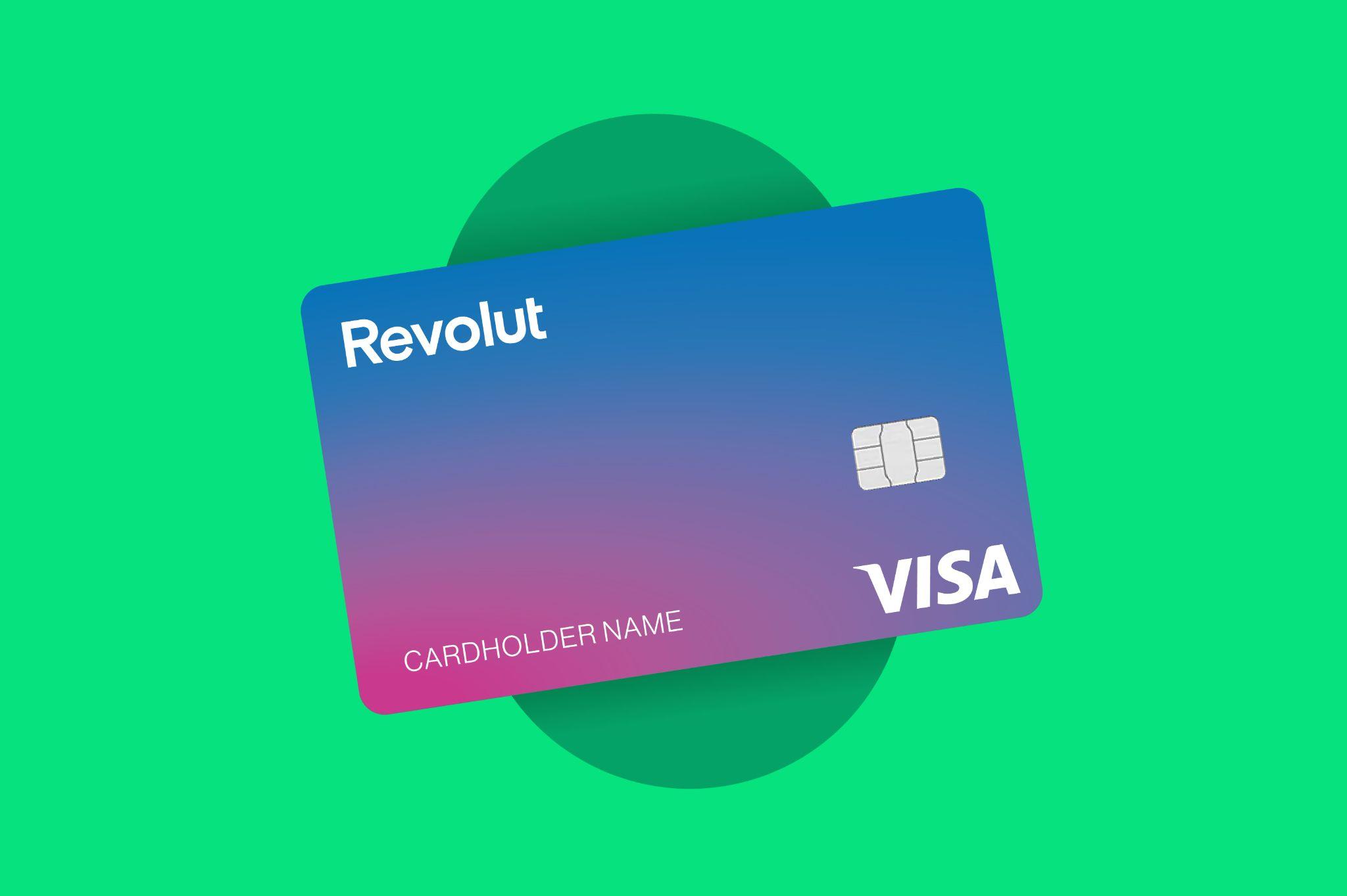
Revolut is a global fintech “super-app” offering multi-currency accounts and spending cards. With it, you can hold dozens of currencies, spend abroad at near-market exchange rates, send international payments, and withdraw cash overseas.
Even Revolut’s free Standard plan includes a multi-currency wallet and debit card; the paid Premium (S$10.99/month) and Metal (S$21.99/month) plans add perks like higher free FX limits, lounge access, and personalised Revolut metal cards.
Revolut charges no FX fee up to the fair-usage limit (e.g. S$5k/month for Standard) and uses market-like rates on weekdays (but it adds a 1% currency exchange fee on weekends for Standard users).
How does Revolut compare with YouTrip? Well, Revolut differs from YouTrip in that it’s not just a travel card. It offers budgeting/analytics tools, crypto trading, stock investing, and even virtual cards. It also provides business accounts and can receive international payroll via local bank details. Importantly, Revolut is regulated in Singapore (it’s a Major Payment Institution under MAS) and even holds a European banking licence, giving it robust credentials.
Pros and Cons of Revolut Card
| Pros | Cons |
| ✅ Multi-currency & global spending: Hold up to approximately 38 currencies & spend in 140+ currencies worldwide with competitive FX rates. | ❌ Weekend/limit fees: Standard plan incurs a 1% FX fee on weekends and 1% over S$5k monthly exchange. |
| ✅ Feature-rich app: Built-in budgeting, savings, crypto/stock trading, and other financial tools. | ❌ Paid plans: Premium/Metal plans (S$10.99–S$21.99) needed for perks; higher tiers may be costly for casual users. |
| ✅ Regulated & safe: MAS-licensed in Singapore; holds EU banking licence. | ❌ Fair usage limits: Standard has FX limit (S$5k/mo) beyond which fees apply. |
| ✅ No FX fees (Standard up to S$5k): On weekdays, exchanges up to the cap are fee-free (using Revolut’s live rate). | ❌ Not fully local bank: No SGD bank account number (unlike a local bank account). |
What Is YouTrip?
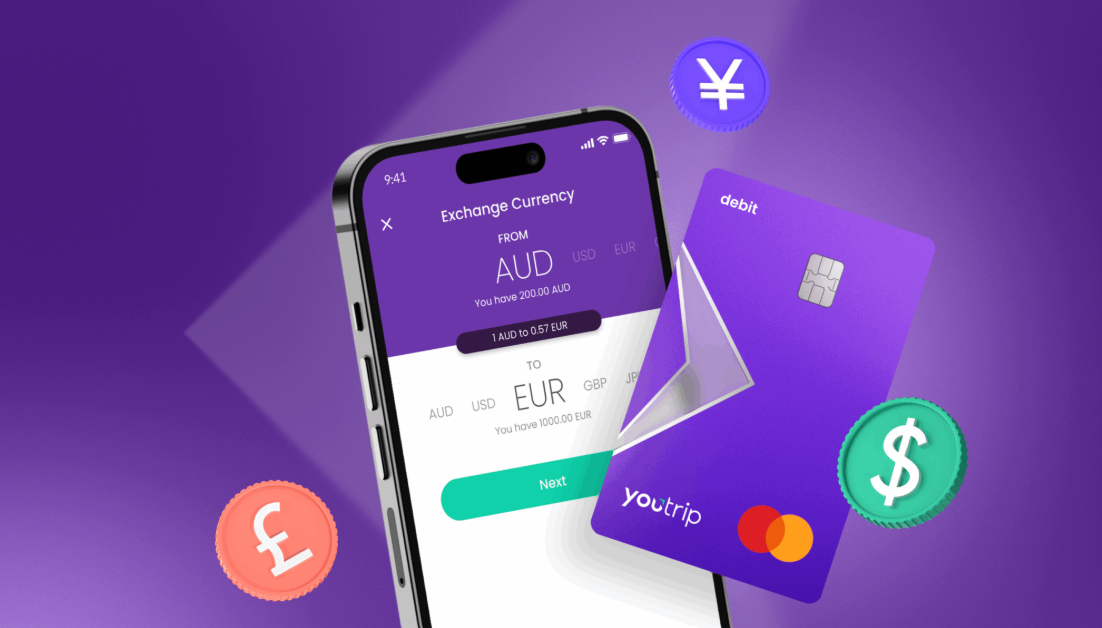
Screengrab from: www.you.co/au/blog/all-you-need-to-know-about-youtrip/
YouTrip is a Singaporean multi-currency travel wallet and card. It’s designed for spending and ATM withdrawals overseas in multiple currencies. Users top up their YouTrip app in SGD and can hold any of 12 currencies (e.g. USD, EUR, GBP, JPY, SGD, MYR, THB, etc.).
When you make a purchase, YouTrip automatically converts at the best rate. Uniquely, YouTrip charges no fees on foreign currency conversion and uses the wholesale (market) rate. This means you’re effectively using the rates shown on search engines, with no hidden markups (YouTrip may add ~0.1% on average, or use Mastercard’s rate for unsupported currencies). There’s also no annual or monthly fee for the YouTrip account.
YouTrip works wherever Mastercard is accepted and in 150+ currencies worldwide. You can withdraw up to S$400 per month from foreign ATMs without fees (then 2% thereafter).
Compared to Revolut, YouTrip offers fewer bells and whistles: no budgeting tools, crypto/stocks, local bank account details, salaries, or investing tools. But if your main need is overseas spending with the lowest costs, YouTrip excels: zero conversion fees, no account fees, and generally better FX rates than typical banks. It’s also MAS-licensed (Major Payment Institution) and safe to use.
Pros and Cons of YouTrip Card
| Pros | Cons |
| ✅ No currency fees: 0% markup on all FX (uses mid-market and Mastercard rates). | ❌ Limited to 12 currencies: Can only preload 12 major currencies. Other currencies convert at the Mastercard rate. |
| ✅ No annual/monthly fees: Completely free account and no foreign transaction fees. | ❌ Travel-focused only: Lacks budgeting/investing features and local bank account functionality. |
| ✅ Wide ATM access: Up to S$400/month free ATM withdrawals abroad. | ❌ Fair usage (top-up) caps: Top-up limit of S$20k (via PayNow/Apple Pay/linked bank card). Can’t exceed daily bank account limits per top-up. |
| ✅ 150+ spend currencies: YouTrip card accepts payments in 150+ currencies. | ❌ No customer support tiering: (Basic support only; no extra perks for users). |
Revolut vs YouTrip Fees
The fee structures differ notably. The table below compares key fees:
| Fee Type | Revolut | YouTrip |
| Account fee | Standard: S$0.
Premium: S$10.99/month. Metal: S$21.99/month. |
No monthly or annual fee. |
| Card issue fee | S$4.99 one-time (physical card). | Free.
S$10 one-time card delivery fee applies to each replacement card requested. |
| ATM withdrawals | Up to S$350/month free; 2% thereafter. | Up to S$400/month free; 2% thereafter. |
| Currency conversion fee | Standard: 0% on weekdays up to S$5k (then 1%).
Premium: 0% up to S$15k (then 0.5%). Metal: 0% always. |
0% always (uses wholesale rates). |
| Weekend FX markup | Standard: +1%.
Premium/Metal: +0%. |
0% (no weekend/after-hours fees). |
| International transfer | To 140+ countries; fees vary depending on currency. | To 40+ countries from the SGD wallet; fees vary (as stated in-app) (transfers to other YouTrip users are instantaneous and free). |
| Top-up fee | Free via local bank/PayNow. | Free with PayNow, Mastercard credit or debit cards, Visa debit cards.
1.5% fee for Visa credit cards. |
In summary, YouTrip avoids all recurring fees for day-to-day use, whereas Revolut’s free plan requires you to watch the limits and occasional markups. YouTrip’s cost advantage is strongest on FX conversions and basic spending; Revolut’s paid plans offset some fees with extra features. What else to note? YouTrip offers more free top-up methods than Revolut.
Revolut vs YouTrip Exchange Rates
Both platforms aim to use rates close to mid-market. In practice:
- YouTrip applies mid-market (wholesale) rates for its 12 currencies and Mastercard’s wholesale rate for others.
- Revolut’s exchange rates are its own, which are usually very close to the interbank rate on weekdays. However, it may apply small markups or fees (e.g. 1% on weekends for Standard users).
To illustrate, the table below shows how much of each foreign currency you’d get for S$100 (using mid-market data). In each case, YouTrip’s rate would be approximately the mid-market figure. Revolut’s figure is slightly lower, assuming a ~1% total markup (Standard plan, weekday):
| Currency | Mid-market (100 SGD) | YouTrip (approx.) | Revolut (approx.) |
| USD (US$) | US$79.01 | US$79.01 | US$78.22 (–1%) |
| MYR (RM) | RM307.69 | RM307.69 | RM304.61 (–1%) |
| JPY (¥) | ¥12,383.7 | ¥12,383.7 | ¥12,259.9 (–1%) |
| THB (฿) | ฿2,458.61 | ฿2,458.6 | ฿2,434.0 (–1%) |
| GBP (£) | £58.46 (calc.) | £58.46 | £57.88 (–1%) |
| AUD (A$) | A$111.47(calc.) | A$111.47 | A$110.36 (–1%) |
| EUR (€) | €67.09 (calc.) | €67.09 | €66.42 (–1%) |
| KRW (₩) | ₩113,536.6 | ₩113,536.60 | ₩112,401.20 (–1%) |
| CNY (¥) | ¥540.88 (calc.) | ¥540.88 | ¥535.47 (–1%) |
Figures are illustrative. Mid-market rates from XE as of 27 Feb 2026. Revolut rates are roughly 1% below mid-market on the Standard plan (weekday).
The takeaway: YouTrip gives you the mid-market sum (as it uses wholesale FX), whereas Revolut Standard gives slightly less (due to its markup and fees). In practice, both are much cheaper than typical bank/credit card rates. YouTrip generally has a small edge on the exchange rates, especially on weekends (Revolut adds 1% then).
Also read: GXS Flexi Loan review
Verdict: Revolut vs YouTrip
Revolut and YouTrip each have clear strengths.
Revolut is the more powerful all-rounder: it not only lets you spend abroad at competitive FX rates (especially on weekdays) but also offers extensive financial tools (budgeting, crypto, investments, business accounts, etc.).
It’s free plan already covers most multi-currency needs, and you can upgrade to paid tiers (Premium/Metal) for added benefits. The trade-off is keeping an eye on fees: Standard users face fair-usage limits and weekend markups.
YouTrip is a simple travel card with virtually no fees. It lets you load up 12 currencies and spend in 150+ currencies worldwide with zero FX markup. There are no subscription fees despite the relatively higher ATM withdrawal allowances.
If your main goal is cost-efficient travel spending, YouTrip is hard to beat. Its drawbacks are its simplicity: no banking details, no extras beyond spending, and only 12 holdable currencies.
Who should choose which? If you value a rich app experience and additional services (and are comfortable with occasional fees), Revolut is probably best. If you just want to pay abroad without hidden costs, YouTrip is likely the better option. Or, why not both? Many travellers use YouTrip for spending, and Revolut for savings, transfers, or when budgeting tools are needed.
Need another solid card for foreign currency spending? Check our review of the Mari Credit Card, which offers competitive foreign exchange rates, no foreign transaction fees, and cashback on your transactions.
Also read our guides on Buy Now, Pay Later (BNPL) in Singapore and Grab PayLater.
Need a personal loan? Find and compare the best personal loans in Singapore now.